
Common OSHA Issues Every Laundry Should Review
Safety is one of those areas of an industrial laundry operation that can be easy to overlook when everything is running smoothly.
Machines are operating. Orders are going out. Employees know their jobs. Production is on schedule.
But a busy operation can also make it easy for small safety issues to become routine.
A missing machine guard, an obstructed walkway, an improperly stored chemical or an employee taking a shortcut during maintenance may not seem significant on a typical day. But each can create unnecessary risk for employees—and potentially expose the company to regulatory problems.
OSHA has specific requirements that apply to laundry machinery and operations, including requirements related to machine guarding and employee instruction.
A periodic safety review can help laundry managers identify problems before they become accidents.
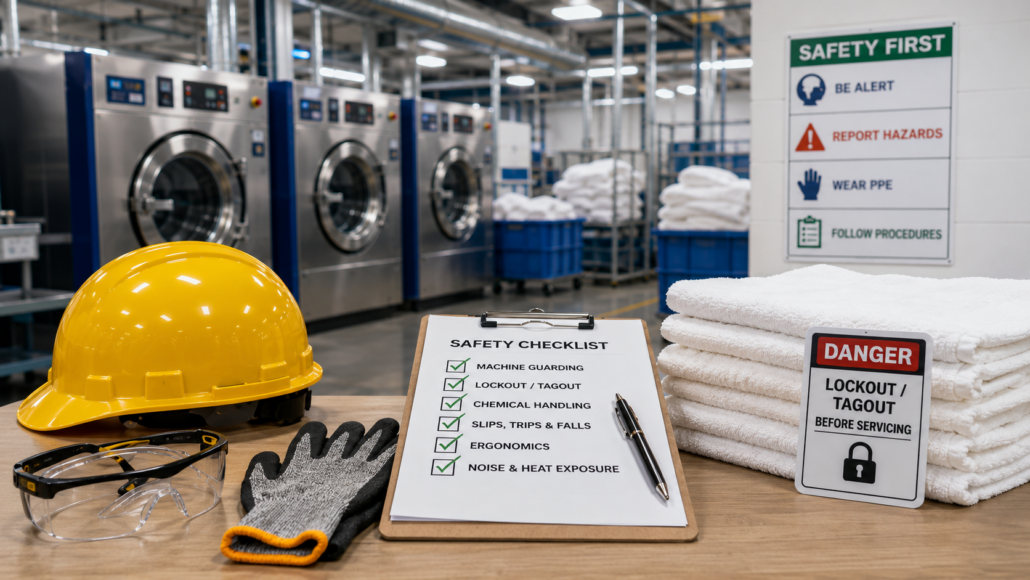
Here are several areas worth reviewing.
1. Machine Guarding
Industrial laundries contain equipment with moving parts, rotating components, pinch points and other areas where employees can be injured.
OSHA’s machine guarding requirements are designed to protect employees from hazards associated with moving machinery. In its laundry guidance, OSHA specifically identifies commercial laundry equipment as a potential source of amputation and strangulation hazards when guards are absent or ineffective.
During a routine walk-through, managers should look for:
- Missing or damaged guards
- Guards that have been bypassed
- Safety devices that aren’t functioning properly
- Employees reaching into operating equipment
- Areas where employees can easily enter a machine’s danger zone
A guard that has been removed for maintenance should not simply become a permanent part of the equipment’s configuration. OSHA’s laundry standard requires safeguards to be replaced immediately after repairs or adjustments are completed.
The takeaway: If a machine’s safety system isn’t working as designed, it deserves immediate attention.
2. Lockout/Tagout
Maintenance and equipment servicing create a different type of risk.
A machine that appears to be turned off may still contain stored or residual energy. Unexpected startup or release of that energy can seriously injure someone working on the equipment.
OSHA’s Lockout/Tagout standard requires employers to establish an energy-control program and procedures for isolating equipment before covered servicing or maintenance takes place. The process includes shutting down equipment, isolating energy sources, controlling stored energy and verifying that isolation has been achieved.
This is an area where written procedures and employee training are particularly important.
Managers should periodically verify that:
- Equipment-specific procedures exist where required
- Authorized employees understand the procedures
- Locks and tags are readily available
- Employees understand who is responsible for applying and removing them
- Procedures are followed consistently
- Periodic inspections and required training are being completed
The takeaway: Lockout/tagout isn’t simply a set of locks hanging on a maintenance-room wall. It’s a complete energy-control program.
3. Chemical Handling
Laundry operations depend on chemicals to deliver the cleaning and disinfection results customers expect.
Those chemicals can also create hazards if they’re improperly handled.
OSHA’s laundry guidance identifies unlabeled containers, chemical splashes and exposure to concentrated detergents and other cleaning chemicals as potential hazards. OSHA’s Hazard Communication Standard also requires employers to provide employees with information about the hazards associated with workplace chemicals.
A chemical-safety review should include:
- Proper labeling of chemical containers
- Access to current Safety Data Sheets
- Employee training
- Appropriate personal protective equipment
- Proper chemical storage
- Procedures for spills and exposures
- Eyewash or emergency flushing facilities where required
Automated chemical dispensing can reduce some handling, but it doesn’t eliminate the need for appropriate precautions when employees change containers, maintain equipment or otherwise handle chemicals.
The takeaway: Automation can reduce exposure, but good chemical safety practices are still essential.
4. Slips, Trips and Falls
Water is unavoidable in a laundry.
A wet floor shouldn’t be.
OSHA specifically identifies wet floors as a slip hazard in laundry environments and requires walking-working surfaces to be kept clean and dry. Aisles and passageways also need to remain clear and in good repair.
Managers should pay particular attention to:
- Water around washers and extractors
- Leaking equipment
- Drainage problems
- Hoses and cords crossing walkways
- Laundry carts blocking aisles
- Uneven flooring
- Poor lighting
- Spills that aren’t cleaned up promptly
The best approach is to make housekeeping part of the operating process rather than something that happens only after a problem is noticed.
The takeaway: A clean, dry and unobstructed production floor is one of the simplest ways to reduce risk.
5. Ergonomics and Material Handling
Laundry employees move a tremendous amount of material every day.
They lift, push, pull, reach, bend and handle wet or bulky textiles. Over time, those repetitive activities can contribute to strains and other musculoskeletal injuries.
OSHA’s laundry guidance specifically identifies excessive reaching, pushing and lifting wet, heavy laundry as potential sources of work-related musculoskeletal disorders. It recommends evaluating the work area and using controls such as well-maintained carts and mechanical aids where appropriate.
Managers should look for opportunities to reduce unnecessary physical effort through:
- Better cart design and maintenance
- Mechanical lifting or dumping equipment
- Proper working heights
- Improved workstation layouts
- Reduced reaching and twisting
- Employee training on safe material handling
The goal isn’t simply teaching employees to “lift correctly.”
It is designing the job so employees don’t have to perform unnecessary or awkward movements in the first place.
The takeaway: Good ergonomics is often good productivity, too.
6. Don’t Forget Noise and Heat
Laundry plants can be hot and noisy environments.
Large washers, dryers, finishing equipment and other machinery can create significant noise levels. OSHA’s laundry guidance notes that employees exposed to an 8-hour time-weighted average of 85 dBA or higher fall under requirements for a hearing conservation program.
Heat is another consideration, particularly around dryers, steam systems and finishing equipment.
A safety review should consider whether employees are appropriately protected from excessive noise and heat and whether engineering or administrative controls can reduce exposure.
The takeaway: Not every workplace hazard is something an employee can see.
Make Safety Reviews Routine
The best safety programs aren’t built around an annual scramble to prepare for an inspection.
They’re built into everyday operations.
A laundry manager who walks the plant regularly, talks with employees and pays attention to how work is actually being performed will often identify potential problems long before they become serious incidents.
It’s also important to remember that OSHA requirements can be specific to the equipment, process and circumstances involved. A safety review should complement—not replace—your company’s formal safety program, training, inspections and professional compliance resources.
The objective is straightforward:
Find the problem before the problem finds you.
Industrial laundries are complex operations, and keeping employees safe requires constant attention. But many of the most important improvements begin with something as simple as taking a walk through the plant and looking at the operation from an employee’s perspective.
At Unilink, we’ll continue sharing practical ideas that help industrial laundries improve operations, control costs and build stronger businesses.
When was the last time you conducted a complete safety walk-through of your laundry?


 Infinite Laundry