
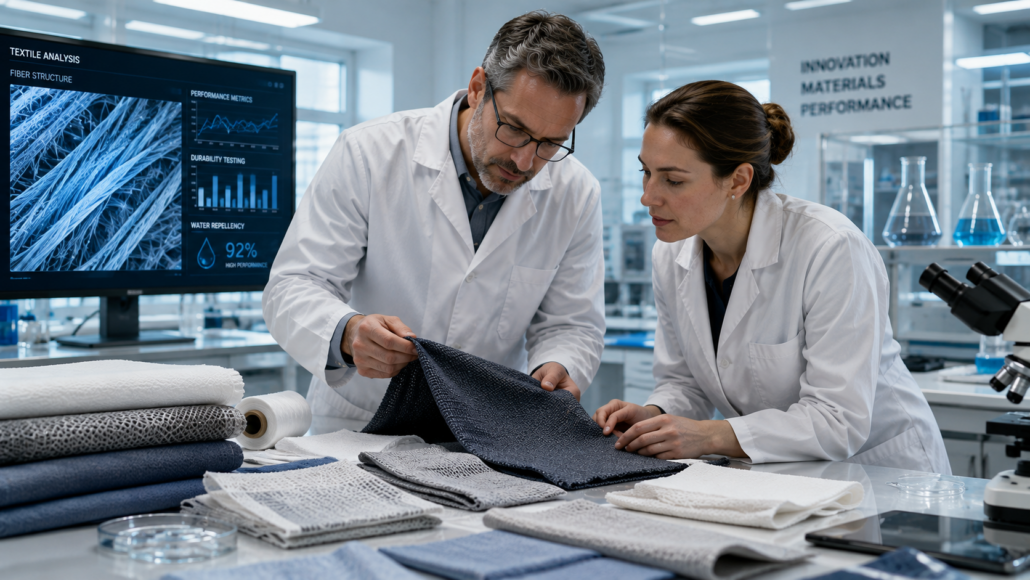
New Textile Technologies Worth Watching
For most industrial laundries, the basic textile hasn’t changed much over the years.
A towel is still a towel. A sheet is still a sheet. A uniform still needs to be durable enough to survive repeated use and repeated trips through an industrial laundry.
But the technology behind those products is changing.
Textile manufacturers are developing fabrics that can do more than simply cover, absorb or protect. Some can carry identification technology. Others are being engineered for greater durability, stretch, moisture management or barrier protection. Still others are being developed with antimicrobial or sensing capabilities.
For rental laundries, these innovations create an interesting opportunity.
The question isn’t simply, “What’s new?”
It’s “Which new technologies can actually create value after a textile has been washed, dried, finished and delivered hundreds of times?”
Here are five areas worth watching.
1. RFID Is Becoming Part of the Textile
RFID isn’t exactly new to the laundry industry. Many rental operators have already implemented RFID to track garments, linens and other assets.
What’s changing is how deeply the technology is being integrated into the textile itself.
Modern RFID laundry tags can be embedded, sewn or otherwise incorporated into products so they can survive repeated industrial laundering. Research into RFID integration methods continues to focus on durability, washability, read performance and resistance to harsh textile-service environments.
For a rental laundry, the potential benefits go well beyond simply knowing where an item is.
RFID can help operators understand:
- How many times an item has been washed
- Where inventory is located
- Which customers have particular items
- How much inventory is missing
- When products are nearing the end of their useful life
- Where production or sorting problems are occurring
TRSA has reported that early RFID adopters have seen benefits including reduced textile ordering, better recovery of missing rental goods and less staff time spent dealing with shortages.
The takeaway: RFID turns an individual textile from an anonymous piece of inventory into a trackable business asset.
2. Performance Fabrics Are Getting More Sophisticated
Textiles used in rental programs have always had to balance competing priorities.
They need to be comfortable enough for the person wearing or using them, but durable enough to survive repeated industrial laundering.
Today’s performance fabrics are increasingly being engineered around specific applications.
That can include:
- Moisture management
- Stretch and mobility
- Improved durability
- Lightweight construction
- Thermal comfort
- Fluid resistance
- Enhanced abrasion resistance
- Improved dimensional stability
Healthcare is one particularly interesting area because garments may need to provide comfort and mobility while also meeting demanding laundering and performance requirements.
The challenge for rental laundries is that a fabric that performs beautifully when new isn’t necessarily a better rental textile.
It has to continue performing after repeated washing, drying, finishing and handling.
That makes lifecycle performance more important than showroom performance.
A textile that costs a little more but maintains its appearance and functionality for substantially more wash cycles may ultimately produce a lower cost per use.
The takeaway: The best new textile isn’t necessarily the one with the most features. It’s the one that continues delivering value after repeated industrial laundering.
3. Antimicrobial and Functional Textiles Deserve Attention—but Also Caution
Antimicrobial textiles have been attracting considerable attention, particularly in healthcare and other environments where textiles are exposed to high levels of use.
Researchers are developing fabrics with antimicrobial treatments and other functional technologies designed to reduce microbial activity on the textile surface. Some research has produced promising results, including technologies designed to maintain antimicrobial activity over extended periods.
But laundry operators should approach these products carefully.
A textile marketed as “antimicrobial” does not eliminate the need for proper laundering.
The CDC specifically recommends caution when considering antimicrobial-treated mattresses, textiles and clothing as replacements for standard textiles and notes that public-health claims associated with treated articles require careful evaluation.
For a rental laundry, the important questions are practical:
- Does the treatment survive the wash process?
- Does it affect the textile’s useful life?
- Does it change the required wash formula?
- Does it provide a meaningful benefit to the customer?
- And perhaps most importantly, is that benefit measurable?
The takeaway: Functional textile treatments may create new opportunities, but the claims need to be evaluated against real-world laundry performance.
4. Smart Textiles Are Moving From Science Fiction Toward Reality
The most intriguing developments may be textiles that can do something beyond their traditional function.
Researchers are developing “smart” and multifunctional textiles that incorporate technologies capable of sensing, responding to or communicating information.
Some applications are still in the research and development stage, but the field is expanding rapidly.
Potential applications include textiles capable of monitoring environmental conditions, tracking use or incorporating electronic functions directly into the fabric.
For industrial rental laundries, however, there is an enormous practical hurdle:
Anything embedded in a rental textile has to survive the laundry.
A technology that works perfectly in a laboratory isn’t necessarily useful if it cannot withstand hundreds of wash cycles, high temperatures, chemicals, extraction, drying and finishing.
That makes washability one of the most important tests for any emerging smart textile technology.
The takeaway: The future of smart textiles may be exciting, but industrial laundries will be among the toughest testing environments those technologies face.
5. More Durable and Sustainable Textiles
Another important area of development is the effort to make textiles both more durable and more sustainable.
That can involve new fiber blends, recycled materials, improved textile construction and manufacturing processes designed to extend useful life.
For rental laundries, sustainability and durability don’t necessarily have to be competing goals.
In fact, a textile that lasts longer can reduce the number of replacement pieces that have to be manufactured, purchased and transported.
This is another reason why cost per use can be more meaningful than purchase price.
Consider two products:
Textile A costs less but requires frequent replacement.
Textile B costs more but survives significantly more wash cycles.
Looking only at the invoice favors Textile A.
Looking at the entire lifecycle may tell a very different story.
The challenge is determining whether a new material actually performs better over time.
That requires tracking textile life rather than relying on assumptions.
The takeaway: Sustainability in a rental laundry starts with understanding how much useful life you get from every textile.
What Should Laundry Operators Do With All This New Technology?
The answer isn’t to replace everything with the newest textile available.
Industrial laundries have too much invested in inventory, processing equipment, chemistry, customer specifications and established workflows to make technology decisions based on novelty alone.
Instead, operators should evaluate new textiles the same way they evaluate any other business investment.
Ask:
Does it solve a real customer problem?
Will it survive our wash process?
Does it reduce our cost per use?
Does it improve inventory control?
Does it reduce labor or processing requirements?
Can we measure the benefit?
And perhaps the most important question:
Will the benefit still exist after the textile has been through 50, 100 or 200 wash cycles?
That last question is particularly important for rental laundries.
A textile isn’t a one-time purchase. It is an asset that generates value over and over again.
The technologies that ultimately make the biggest impact will be the ones that recognize that reality.
The future of industrial textiles probably won’t be defined by one breakthrough fabric.
It will be defined by the combination of better materials, better tracking, better durability and better information about how textiles actually perform in the real world.
At Unilink, we’ll continue watching these developments and sharing the technologies that have the potential to make a real difference for industrial laundry operators.
What new textile technology are you seeing that you think could have a meaningful impact on the rental laundry industry?


 Infinite Laundry