
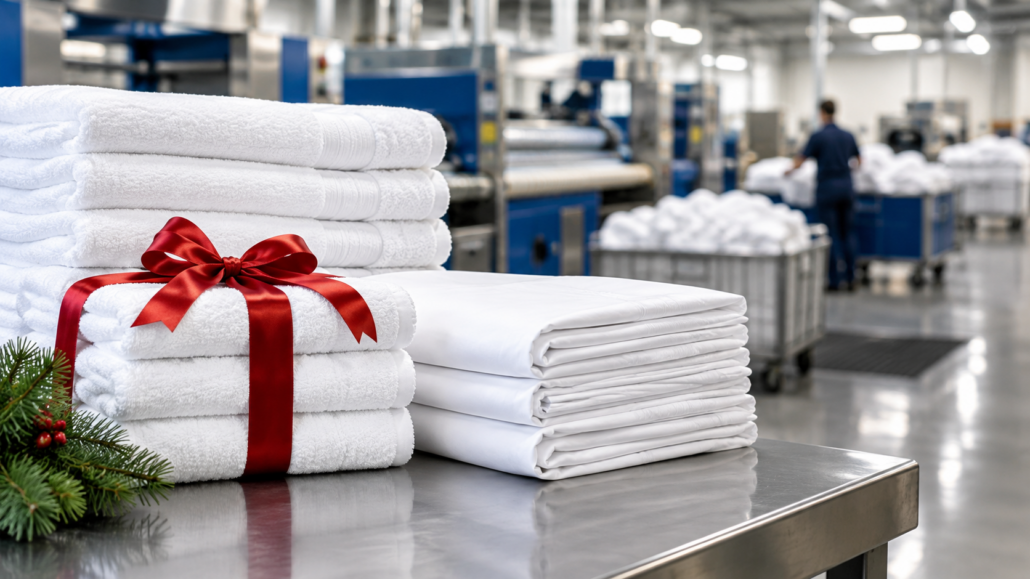
The Holiday Rush Is Coming: Is Your Laundry Ready?
The holiday season can bring a welcome increase in business for industrial laundries serving hotels, restaurants, event venues, healthcare facilities, and other commercial customers. But additional volume can also expose weaknesses in staffing, equipment reliability, textile inventory, and delivery schedules.
The challenge isn’t simply processing more laundry. It’s maintaining the service customers depend on while keeping costs, overtime, and operational disruptions under control.
According to the American Hotel & Lodging Association’s 2026 State of the Industry report, hotel guest spending is projected to reach nearly $805 billion in 2026, even as operating expenses remain elevated. That combination reinforces the importance of operational efficiency for businesses serving the hospitality industry.
For laundry owners and managers, the best time to prepare for the holiday rush is before the first unexpected order arrives.
1. Forecast demand before it reaches the plant
A busy holiday season rarely affects every customer in the same way. Hotels may experience changes in occupancy, restaurants may book additional private events, and banquet facilities may need substantially more table linens and napkins.
Start by reviewing last year’s seasonal volume alongside current customer forecasts. Look for changes in order frequency, pounds processed, special-event requirements, and delivery patterns.
Then contact key customers and ask a few straightforward questions:
- Are you expecting more guests, events, or operating hours this season?
- Will you need additional sheets, towels, uniforms, tablecloths, or napkins?
- Are there dates when your normal delivery schedule will be difficult?
- Have your operating plans changed since last year?
Use those answers to build a realistic forecast by customer and product category. Avoid assuming that last year’s numbers will automatically repeat.
The Textile Rental Services Association’s 2026 industry outlook highlights how operators are adapting to shifting customer needs and seasonal opportunities, including demand for banquet linens and event-related textiles.
The goal: Identify where demand is likely to increase while there is still time to adjust staffing, production, inventory, and routes.
2. Find your production bottlenecks
More incoming laundry doesn’t necessarily mean every department needs more capacity. Sometimes one stage of the operation limits the entire plant.
Review the full production process, from receiving and sorting through washing, drying, finishing, folding, packing, and shipping. Ask supervisors where work tends to accumulate during a normal week.
Pay particular attention to:
- Finishing equipment: Can folders, ironers, and other finishing equipment keep pace with projected volume?
- Washroom capacity: Are machine availability, cycle times, and loading practices supporting efficient production?
- Labor allocation: Are enough trained employees available at the stages that typically slow down?
- Shipping and staging: Is there sufficient space to keep completed orders organized and ready for dispatch?
- Changeovers: Will an increase in different product types create additional sorting or finishing demands?
The Textile Rental Services Association’s industry outlook emphasizes the value of improving internal operations before committing to larger expansions. It also discusses how equipment upgrades and automation can improve throughput and address labor constraints.
You may not need new machinery to handle the holidays. Better scheduling, improved workflow, or resolving a recurring bottleneck may deliver more immediate benefits.
3. Schedule maintenance before equipment fails
A machine that fails during a peak production period creates more than a repair bill. It can delay orders, force production changes, increase overtime, and put customer relationships under pressure.
Review maintenance records for recurring problems and identify equipment that deserves attention before seasonal volume increases. Check that routine inspections, lubrication, cleaning, and manufacturer-recommended maintenance are current.
Also consider the supporting systems that keep production moving, including steam, water treatment, compressed air, ventilation, and wastewater equipment.
The TRSA’s 2026 outlook specifically highlights basic upkeep, including repairing leaky steam traps, as an often-overlooked opportunity to improve efficiency. The article also discusses predictive maintenance as one way technology can help reduce variability in plant performance.
Review your contingency plan, too. If a critical machine becomes unavailable, do employees know how production will be reassigned? Are qualified repair technicians and essential replacement parts accessible? Is there an alternative way to meet priority customer commitments?
Preventive maintenance is not just a facilities task. It is part of protecting your ability to deliver on time.
4. Check textile and supply inventories
A plant can have enough labor and machine capacity and still fall behind because it lacks the right textiles, replacement items, or operating supplies.
Review inventory for products that are particularly important during the holidays. Depending on your customer mix, these may include table linens, napkins, towels, bed linens, uniforms, shop towels, and floor mats.
Don’t limit the review to clean textiles waiting to be delivered. Consider the entire inventory cycle:
- Items currently in customer use.
- Soiled items awaiting collection or processing.
- Items in production or transit.
- Clean inventory ready for delivery.
- Items unavailable because of damage, wear, or loss.
The American Laundry News article on commercial laundry supply-chain challenges, published in August 2026, recommends maintaining safety stock of critical items, improving inventory visibility, and developing relationships with multiple suppliers to reduce supply risk.
Use your own consumption and replacement history to determine appropriate stock levels. Buying more of everything is not the answer; having the right items available at the right time is.
5. Build a realistic staffing and delivery plan
Holiday schedules can put pressure on both plant operations and route services. Employees may request time off, school and family schedules may change availability, and customers may need deliveries on different days than usual.
Create a staffing plan that accounts for expected absences, peak production days, and the skills required at critical workstations. Identify cross-trained employees who can provide backup and make sure supervisors understand their responsibilities if volume exceeds the forecast.
At the same time, review route capacity and delivery commitments. Confirm holiday operating hours with customers, identify potential scheduling conflicts, and communicate changes before they become urgent.
Avoid building a plan that depends on overtime as the primary solution. Overtime may be necessary, but relying on it every day can raise costs and put additional pressure on employees when they are already working hard.
The TRSA’s 2026 outlook identifies labor availability and workforce development as continuing concerns for laundry operators.
Cross-training, clear communication, and realistic scheduling can help your existing team respond more effectively when demand rises.
6. Talk to customers before problems arise
Customers are more likely to work with you through a challenging period when they understand what to expect. Silence, missed deliveries, and last-minute explanations can turn a manageable disruption into a relationship problem.
Before the holiday period begins, confirm important delivery dates, special orders, operating-hour changes, and any unusual requirements. Establish a clear process for handling urgent requests and communicating delays.
Internally, make sure customer service, route drivers, production supervisors, and management are working from the same information.
The American Laundry News supply-chain report also emphasizes customer communication as an important way to set expectations and strengthen business relationships when challenges occur.
Proactive communication does more than prevent confusion. It demonstrates that your business is organized, responsive, and focused on helping customers succeed during their busiest season.
7. Prepare for the unexpected
Even a well-planned holiday season can be disrupted by severe weather, equipment failures, supplier delays, unexpected employee absences, or a sudden change in customer demand.
Identify the situations most likely to affect your operation and decide in advance how you will respond. Your contingency plan should address questions such as:
- Who makes decisions when the plant cannot operate normally?
- Which customers and orders receive priority?
- What backup arrangements are available for critical equipment or supplies?
- How will customers be notified about service disruptions?
- Who is responsible for coordinating recovery and revised delivery schedules?
The American Laundry News supply-chain article stresses the importance of planning for disruptions before they affect service. That principle applies just as much to a holiday production surge as it does to a broader supply-chain problem.
You don’t need a complicated emergency manual to get started. A clear, documented plan with assigned responsibilities is far more useful than making decisions from scratch under pressure.
Your holiday-readiness checklist
Before the season gets busy, use this checklist to identify gaps and assign responsibility.
- Review last year’s seasonal volume and forecast current customer demand.
- Confirm holiday schedules and special requirements with key customers.
- Identify production bottlenecks and adjust workflow where needed.
- Complete priority preventive maintenance and review backup arrangements.
- Check critical textile, chemical, parts, and operating-supply inventories.
- Confirm employee coverage, cross-training, and supervisory responsibilities.
- Review route capacity, delivery schedules, and customer communication procedures.
- Document contingency plans for equipment failures, supply delays, and staffing gaps.
Assign an owner and a completion date to each item. A checklist only helps when someone is accountable for acting on it.
A smoother holiday season starts now
The holiday rush doesn’t have to mean putting your operation into crisis mode. With realistic forecasting, reliable equipment, adequate inventory, prepared employees, and clear customer communication, your laundry can be better positioned to manage changing demand without sacrificing service quality.
The work you do before the season begins can help reduce last-minute decisions, protect your margins, and strengthen customer confidence when reliability matters most.
Don’t wait until your plant is behind schedule to discover what needs attention. Prepare now, so your team can focus on delivering when customers need you most.


 Infinite Laundry