
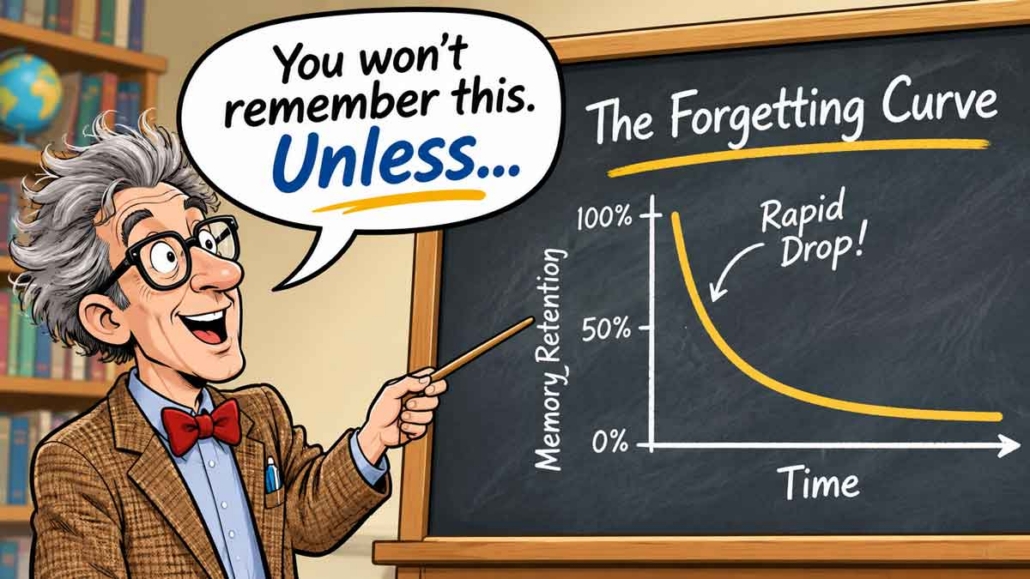
The Forgetting Curve: Why Your Customers Forget You (And What to Do About It)
I’m going to tell you something important. But chances are, you won’t remember it.
Unless you do some very strange things.
Don’t worry. We’ll get to that in a minute.
Recently, Levi Nix from M+A Matting stopped by to visit us and introduced us to an interesting psychological concept called the Forgetting Curve. It’s an idea with some surprisingly practical implications for marketing and sales in the industrial laundry business.
Your Brain Is Wired to Forget
Back in the late 1800s, German psychologist Hermann Ebbinghaus conducted experiments to understand how people remember information. His discovery? We forget new information surprisingly quickly.
The biggest drop in memory happens shortly after learning something. As time passes, the rate of forgetting slows down.
Think about it. Someone introduces you to a new idea at a meeting. You find it interesting. You might even tell someone about it later that day. But a week from now? There’s a good chance you’ve forgotten most of it.
Unless, of course, you encounter that information again.
That’s the key.
Research shows that reviewing information at spaced intervals helps people retain it longer. It’s called spaced repetition.
And it’s a lesson every industrial laundry business should pay attention to.
Your Customers Are Forgetting You, Too
Imagine meeting a hotel manager at an industry event. You have a great conversation about linen quality, delivery reliability, and the challenges of managing inventory.
The manager is interested. You exchange cards and promise to follow up.
Then real life takes over.
Staffing problems, guest complaints, supply shortages, and daily operations push your conversation to the back of the manager’s mind.
A month later, when they’re thinking about their laundry provider, your company may not even come to mind.
It’s not personal. It’s human nature.
If customers don’t regularly hear from you, they are likely to forget what makes you different.
Marketing: Stay on Their Radar
The goal of marketing isn’t just to get someone’s attention once. It’s to build enough familiarity that your company comes to mind when they need what you offer.
Think about the problems your customers face:
- Hotel managers worry about linen shortages and inconsistent quality.
- Facility managers need clean, safe entrance areas.
- Restaurant owners want dependable table linen service.
- Safety managers look for ways to reduce workplace hazards.
If your company consistently shares useful information about these issues, customers begin associating your name with the solutions.
LinkedIn posts, email newsletters, educational articles, customer stories, and industry updates all help reinforce that connection.
The trick is to provide value rather than repeat the same sales pitch. Give people a reason to pay attention.
Sales: Don’t Let Good Conversations Disappear
The Forgetting Curve also explains why one follow-up email rarely does the job.
A prospect may genuinely be interested but simply get distracted by other priorities.
Instead of relying on memory or waiting for the prospect to call, build a follow-up process:
- Immediately: Send a thank-you email summarizing your conversation.
- A few days later: Share useful information related to their specific needs.
- A week or two later: Follow up and ask if they have questions.
- Over time: Stay in touch with relevant updates, ideas, and solutions.
Not every contact needs to be a sales pitch. Sometimes the best way to stay memorable is to be helpful.
And don’t forget existing customers. When everything is running smoothly, they can lose sight of the value you provide, too. Regular service reviews and useful suggestions reinforce why they chose you in the first place.
So, What Were Those Strange Things?
Remember my opening promise? I said you probably wouldn’t remember something important unless you did some very strange things.
Those strange things are simply repeating what you’ve learned at intervals.
It’s the same principle that helps students remember information, and it can help your business stay in the minds of customers and prospects.
The bottom line is simple:
Out of sight often means out of mind.
Industrial laundry is a relationship business. Building relationships takes time, and maintaining them takes consistent communication.
Thanks to Levi Nix of M+A Matting for introducing us to the Forgetting Curve. It’s a timely reminder that what customers remember about your business tomorrow may depend on what you do to stay in touch today.
Now, let’s see how much of this article you remember next week!


 Infinite Laundry