
How Much Water Does an Industrial Laundry Really Use?
Water is one of those expenses that can be easy to overlook in an industrial laundry.
You know what your water bill is. You probably know how many pounds you process. But do you know how many gallons of water you’re using to process each pound?
That number can tell you a lot about how efficiently your plant is operating.
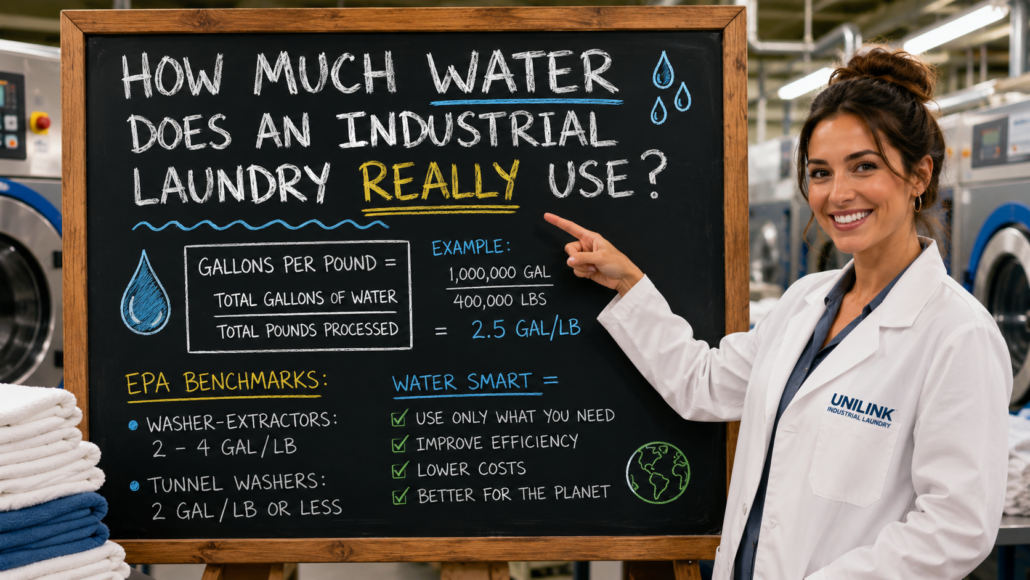
EPA WaterSense guidance puts typical washer-extractor water consumption at roughly 2–4 gallons per pound, while tunnel washers typically use 2 gallons per pound or less. But those numbers are benchmarks—not a universal target. Actual consumption depends on equipment, product mix, soil levels, wash formulas, water levels and operating practices.
For a laundry manager, the important question isn’t simply whether your operation is above or below someone else’s number.
It’s whether your gallons-per-pound number is moving in the right direction.
Start With Gallons Per Pound
The simplest way to measure water efficiency is:
Total gallons of water used ÷ total pounds processed = gallons per pound
For example, if a plant uses 1,000,000 gallons of process water to wash 400,000 pounds of laundry, its water consumption is:
2.5 gallons per pound
That number becomes much more useful when tracked over time.
EPA’s current WaterSense guidance says most washer-extractors require approximately 2–4 gallons of water per pound of laundry, depending on the machine, number of wash cycles and water-level settings. Efficient tunnel washers typically use 2 gallons per pound or less.
The takeaway:
Don’t just watch the water bill. Watch the gallons required to produce a pound of clean laundry.
What Should Your Number Be?
There isn’t one number that every industrial laundry should be trying to hit.
A plant processing lightly soiled hospitality linens doesn’t necessarily have the same water requirements as one processing heavily soiled industrial uniforms or shop towels.
EPA specifically points out that the number of wash cycles and water levels can vary according to the level of soil. Separating laundry by soil level can therefore have a direct effect on total water consumption.
That means comparing your laundry to another facility based solely on gallons per pound can be misleading.
Instead, establish your own baseline and ask:
- Are you processing similar products from week to week?
- Are water levels appropriate for the load?
- Are loads consistently being filled to their intended capacity?
- Are heavily and lightly soiled products being separated appropriately?
- Are wash formulas using more cycles than necessary?
- Has water consumption increased even though your product mix hasn’t changed?
The goal isn’t simply to use less water.
The goal is to use the right amount of water to consistently produce the required level of cleanliness.
Calculate Your Actual Water Consumption
EPA provides a straightforward way to estimate water use for washer-extractors and tunnel washers.
The calculation is:
Water use = water-efficiency factor × pounds of laundry per load × number of loads
For example, consider a washer with a water-efficiency factor of 2.5 gallons per pound processing 500 pounds per load over 2,000 loads per year.
2.5 × 500 × 2,000 = 2,500,000 gallons per year
That gives management a much clearer picture of how much water a particular machine is responsible for consuming.
You can apply the same concept across your operation to develop a plant-wide gallons-per-pound number.
Once you have it, you have a baseline.
And once you have a baseline, you can start looking for improvement.
Your Product Mix Matters
Two laundries can have very different water requirements even if they process the same number of pounds every week.
The reason is simple: not every pound of laundry is the same.
Heavily soiled goods may require additional wash or rinse cycles. Lightly soiled goods may not.
A facility that mixes everything together and runs an aggressive formula on every load could be using considerably more water than necessary.
That doesn’t mean cutting cycles indiscriminately. If reducing water results in poor cleaning and additional rewash, the laundry hasn’t actually become more efficient.
Instead, look for opportunities to match the process to the product:
Separate by soil level. Heavier soil may require additional processing, while lightly soiled goods may not.
Review formulas periodically. Wash formulas can evolve as chemistry, equipment and customer requirements change.
Check water levels. Make sure machines aren’t routinely using more water than the load requires.
Load machines properly. Underloaded machines can waste water, energy and chemistry relative to the amount of laundry being processed.
EPA recommends washing full loads and separating laundry according to the number of wash cycles required.
Equipment Makes a Difference
The equipment doing the washing is one of the biggest factors affecting water consumption.
Washer-extractors can be highly effective, but their water requirements vary according to machine design, load size, water levels and the number of cycles used.
Tunnel washers take a different approach.
These large-volume continuous-batch machines use multiple compartments and countercurrent water flow. Fresh water enters toward the final rinse and then moves through earlier stages of the process before eventually going to the drain.
That allows the same water to be used through multiple stages of the wash process.
According to EPA WaterSense, tunnel washers can reduce water consumption by 30–60% compared with less efficient approaches and typically use 2 gallons of water or less per pound.
That doesn’t automatically make a tunnel washer the right choice for every laundry. Capital investment, production volume, product mix, available space and operating requirements all have to be considered.
But for high-volume operations, water efficiency should be part of the equipment conversation—not an afterthought.
Don’t Forget the Water You’re Heating
Water costs more than the price charged by your local utility.
In an industrial laundry, a significant amount of the process water may need to be heated. That means reducing hot-water consumption can also reduce the energy required to heat that water.
EPA specifically notes that reducing laundry water use can produce energy savings because less water needs to be heated.
This creates an important connection between two expenses that are often managed separately:
Water efficiency → less water heated → lower energy demand
The exact savings will depend on your water, wastewater and energy rates, as well as your equipment and operating conditions.
But when evaluating a process improvement or equipment upgrade, the water savings shouldn’t be considered in isolation.
Look for Water That Isn’t Adding Value
One of the most useful exercises a laundry can perform is to look for water that isn’t contributing enough to the finished product.
That doesn’t necessarily mean eliminating wash or rinse cycles simply to save water.
Instead, look for opportunities such as:
Optimize water levels. Make sure machines aren’t routinely using more water than the load requires.
Review wash formulas. Periodically evaluate whether every cycle and rinse is still necessary.
Separate products appropriately. Washing goods according to their actual soil level can prevent lightly soiled items from receiving unnecessarily intensive formulas.
Use recycling where practical. EPA recommends considering washer-extractors with built-in water recycling capabilities. Some systems can use less than 2.5 gallons per pound.
Monitor equipment performance. A change in water consumption can sometimes indicate an equipment, control or operating problem.
The objective isn’t to minimize water at any cost.
It’s to eliminate water use that doesn’t add value.
Put a Dollar Value on the Opportunity
Once you know your gallons-per-pound number, you can begin translating efficiency improvements into dollars.
Suppose a plant processes 500,000 pounds per month and currently uses 2.5 gallons per pound.
That’s:
1.25 million gallons per month
If the plant could reduce consumption to 2.2 gallons per pound without affecting quality, it would save:
150,000 gallons per month
That’s 1.8 million gallons per year.
The actual financial impact will depend on the cost of incoming water, wastewater treatment, sewer charges and the energy required to heat the water.
But the calculation gives management a starting point for determining whether a proposed improvement deserves further investigation.
EPA recommends considering facility-specific costs for water, wastewater and energy when evaluating the payback of laundry equipment improvements.
Real-World Numbers Can Be Surprisingly Different
EPA research into industrial laundries demonstrates why there isn’t one universal benchmark.
In one EPA study of several industrial laundry plants, reported water consumption ranged from approximately 1.9 to 2.4 gallons per pound across the facilities studied.
Those figures show what is possible—but they shouldn’t be treated as a universal standard for every laundry.
The age and type of equipment, product mix, wash chemistry, soil levels and operating practices can all affect the result.
That’s why your own trend line may be more valuable than someone else’s benchmark.
If your plant is consistently at 3.0 gallons per pound, for example, and gradually moves to 2.7 without sacrificing quality, you’ve made a measurable improvement.
Make Water Efficiency a KPI
Water consumption shouldn’t be something you review only when the utility bill arrives.
Add gallons per pound to the plant’s regular performance reporting.
Track it weekly or monthly alongside other operational measures such as:
- Pounds processed
- Pounds per labor hour
- Rewash percentage
- Equipment downtime
- Utility consumption
- On-time delivery
Then look for trends.
If gallons per pound are falling, that’s a sign that your processes may be getting more efficient.
If they’re climbing, ask why.
A change could be caused by product mix, heavier soil, a change in wash formulas, equipment performance, production practices—or simply a measurement issue.
The important thing is that the number gives you somewhere to start.
The Bottom Line
There is no universal gallons-per-pound target that applies to every industrial laundry.
The better question is:
How much water should your laundry be using for the work it actually does?
Start by measuring your current consumption. Establish your gallons-per-pound baseline. Then look for opportunities to reduce water without sacrificing cleanliness, quality or customer expectations.
For an industrial laundry, water efficiency isn’t just an environmental initiative.
It’s an operating-cost issue.
And the first step toward improving it is knowing your number.
Sources
U.S. Environmental Protection Agency — WaterSense at Work: Laundry Equipment
EPA WaterSense guidance, May 2023.
U.S. Environmental Protection Agency — Pollution Prevention at Industrial Laundries
EPA study documenting water consumption at several industrial laundry facilities.
U.S. Environmental Protection Agency — WaterSense at Work: Best Management Practices
Guidance covering laundry equipment, water efficiency and operational practices.


 Infinite Laundry